Thursday, May 16, 2013

Mexican Black Bean Wrap with Pico De Gallo


Mexican cuisine is very dear to my heart for various reasons. One of the first cuisines I tasted, after I came to US was undoubtedly, Mexican. Since the food packs quite a punch with good level of heat and tangy flavors, it sings to my heart and appeals to my Indian palate. Be it the gooey Guacamole with rich buttery mashed Avocados dipped in Corn chips, the overloaded and stuffed Tacos which is a super cheap, quick meal if you are a student in US studying on a limited budget for food or the humble everyday dish of re-fried beans served with Mexican rice, the truth clearly stands out - they are all made with zesty and fresh ingredients, have a spicy edge and are very easy to fix.

One of the biggest blessing for the Roti lover in me is the unlimited options and varieties of Tortillas available at my local grocery. From the traditional Corn Tortillas made from Masa flour to the healthy variety of Tortillas made of Whole Wheat Flour and often even Spinach Tortillas, the options are endless and one can plan a decent meal with less than 15 minutes of prep work.

Days when I do not have the inclination to move a muscle, I happily opt for Black Bean Wraps made of Honey-Wheat Tortillas. They have a mild sweet taste and do not break easily when added with a stuffing. Pico De Gallo is the version made in many Mexican homes similar to what Kachumbar or Koshimbiri is to all Indians.  The wraps are very portable and great as outdoor foods.

Mexican Black Bean Wrap with Pico De Gallo 
A quick and easy wrap made of Black Beans

Prep Time: 5 minutes
Processing Time: 10 minutes

Ingredients:
For Pico De Gallo -
Tomatoes (ripe, finely chopped, pulp drained) - 1 cup
Shallots (finely chopped) - 1/4 cup
Jalapeno (seeds and membranes removed, finely chopped) - 2 tbsp
Lime juice -  1 tsp
Salt

Black Beans (soaked, pressure cooked with salt) - 2 cups
Cheese of choice (grated) [Monterey Jack Cheese with Jalapenos] - 1/2 cup
Coriander leaves (roughly chopped) - 3 tbsp
Crushed Black Pepper - 1/2 tsp

Tortillas (Honey-Wheat variety) [store bought] - 4-6

Method:
Remove the inner membrane of Jalapeno and finely chop into tiny bits. Mix with chopped Tomatoes, Shallots, lime juice and salt (remove the seeded pulp of Tomatoes as the water content will make the wrap soggy, just retain the outer thick skin).
Mix the cooked black bean with little salt and crushed black pepper powder and keep aside. Grate the cheese on box grater.
Warm both sides of a Tortilla on Tawa for a minute. Transfer to a work surface. Place a tbsp of Pico, add a tbsp black beans, garnish with a a tsp of grated cheese and coriander leaves. Add a dash of lime juice. Fold the sides and then wrap like a log. Too much stuffing and the wraps break, stuff with caution. Slice diagonally with a knife to divide into two portions. Transfer to a serving dish. The wraps are portable and great as appetizers. Warm for 30 seconds in MW just before serving for home style flavor.

Thursday, May 2, 2013

Horsegram Side Dish - Konkani style (Kulith Upkari)


Horsegram also known as Kulith in Konkani is a popularly used pulse. I've earlier blogged about Kulith Saaru, a family favorite and Kulith Koddel, which is another personal favorite dish. Once cooked, Kulith beans pack a powerhouse of energy and are equally high in Calcium and Protein. In India, its also popularly cooked and offered to cows as cattle feed.

Kulith Upkari, a side dish made in many Konkani homes pairs well with Rotis. Strangely, it was not the most sought after dish in my parents home nor in my grandparents home. Guess, the default option was always a Koddel because it was a one pot meal and fed many mouths. Much respite and easier day for the home cook!

Kulith Upkari 
A Konkani style side dish made with Horsegram

Prep Time: 6-10 hours
Cook Time: 45 minutes

Ingredients:
Horsegram (soaked, pressure cooked) - 3/4  cup

For Seasoning -
Mustard seeds - 1/2 tsp
Red Chillies (split into two) - 2
Green Chillies (slit lengthwise) - 1
Curry leaves - a sprig
Asafoetida - 1 pinch
Coconut oil

For Garnish -
Grated coconut - 2 tbsp

Method:
Clean the beans and remove any grime and dirt. Wash and rinse in multiple changes of water. Soak for 8-10 hours. Pressure cook for 4-5 whistles. Allow to cool. Save the stock of cooked beans for  making Kulith Saaru.
In a deep bottomed vessel, heat a few spoons of coconut oil. Once the oil is hot enough, season with mustard seeds. Once the seeds splutter, add the curry leaves and broken red chillies. Add the asafoetida now and give a good stir. Transfer the cooked beans to the seasoning, give a good mix. Season with salt, sprinkle 1/2 cup of warm water and cover with a lid. Cook for 5-10 minutes by bringing to boil and then simmer away. Once done, garnish with grated coconut. Fish out the chillies if required before serving. Serve with Rotis or as a side dish.

Thursday, April 18, 2013

Pan roasted Asparagus in Za'atar with Orange Zest


Spring season implies the entry of few of my favorite vegetables and greens - Asparagus, Artichokes, Arugula and many versions of Chard greens. Asparagus - grilled, roasted or steamed is a favorite in my home. I've tried to doctor the vegetable with Indian spices, but they seemed too overpowering. 

A recent hot favorite in my home are two Middle Eastern spice powders - Za'atar and Sumac. I've been using Sumac in Indian food as well since it renders a nice tangy finish, much like lemons to a dish. Sumac is a much darker, brown colored spice blend with a deep, lemon like tangy flavor. Za'atar as a spice blend is like a silent soldier whose presence is felt yet is very understated and subtle. Za'atar spice blend comes in various combination of spices blended to a dry powder depending on various geographies of Middle East. For instance, a Lebanese version of Za'atar is very different from the ones used in Jordan. The one I use is a blend of Thyme, Oregano, Sumac, Sesame seeds and Marjoram. The usage of Za'atar is diverse and plenty - garnish a bowl of Hummus, season the Falafel sandwich, add as a topping on a Pizza or Bread or use it for a salad.

Za'atar spice blend - Sumac, Sesame seeds, Thyme, Oregano and Marjoram

The interesting things about Asparagus is, it retains the moisture and remains juicy even after cooking owing to high water content. We prefer the spears when they are a bit overcooked, but you could stop after 15 minutes and serve. 

Pan roasted Asaparagus in Za'atar and Orange Zest

Prep Time: 5 + 10 minutes
Cook Time: 15-25 minutes

Ingredients:
Asaparagus (stem removed) - 5-10 spears

For the seasoning -
Za'atar spice blend - 1/2 tsp
Black Pepper Powder (crushed) - 1/3 tsp
Turmeric powder - just a pinch
Sea Salt
Extra Virgin Olive Oil 

For garnish -
Orange zest - 1/2 tsp

Method:
Cleaning Asparagus - The Asparagus spears you get at local markets here are cleaned, trimmed and banded together. Wash the spears under cool water, pat dry. Hold the bottom half and snap off from the top end. The trick here is it will snap at the point where the woody part separates from the tender part. Reserve the bottom pieces for soups, stocks. 

Make a marinade of the seasoning ingredients and add the spears. Give a good toss and leave aside for 10 minutes. Heat a cast iron pan to smoking high heat. No need to add oil. Add the spears side by side. Do not use a spatula. Cook on a high flame for 2-4 minutes and cook on low flame for 15-20 minutes. Frequently, give a good toss by gently shaking the pan. Once they are lightly charred, turn off flame and serve hot with a dash of orange zest.

Monday, April 8, 2013

Jackfruit Seed Saar (Bikand Saaru)


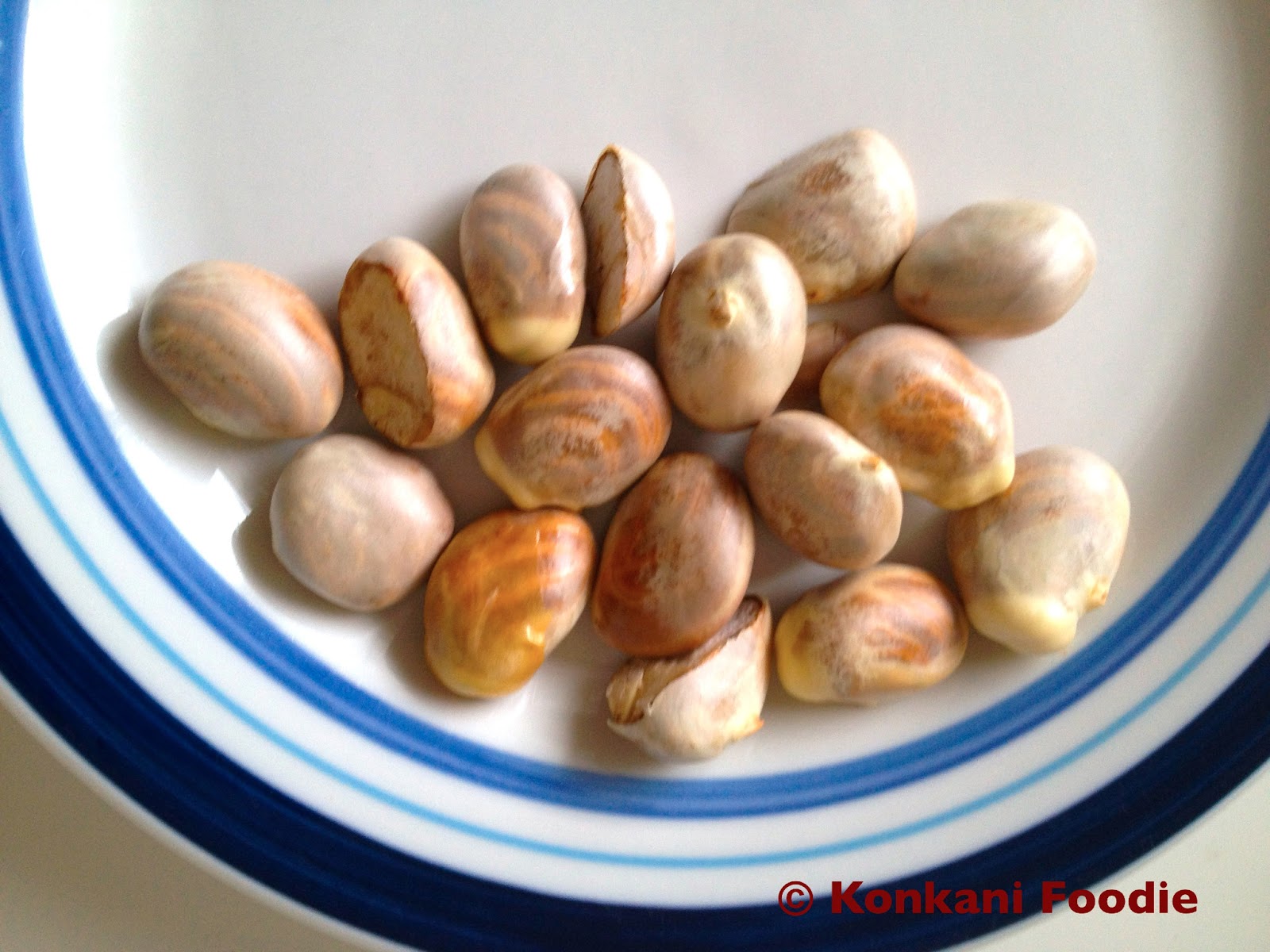
Few weeks back, I found a small portion of ripe Jackfruit at Indian grocery store. I was delighted and almost had the mind to buy the entire lot had it not been the cleaning process (which is a messy task) and that thought which promptly curbed my brimming enthusiasm. I had initially planned on making Gharayi, a sweet dish made of Jackfruits which Ma would often make for us when the ripe fruits were in season. I was happy to have found this fruit after ages. The Jackfruit kernels were super sweet and both of us finished the plate clean in no time. Left, were the seeds which I saved without a rhyme or reason. Everyday when I spotted the dozen seeds sitting on the counter, it filled me with memories of one women whom I owe a lot in my life in addition to my dear Ma. 

The Jackfruit seeds reminds me of my Ammama (my Grandma). She was one woman who was very fond of seasonal produce and more specifically - Mangoes and Jackfruits. I had earlier written about the Jackfruit tree in the backyard of my Grandparents house which I am obsessively fond of. I left the seeds on the counter in open air to dry off. After 5-7 days, the ash grey skin easily comes off. What remains is the brown seed which is suitable for this recipe.

When we were kids, Amamma had the official responsibility of feeding over a dozen mouths during our summer vacation. I dread to think how she pulled off the job with lot of grace and dignity. During hot blazing summer, when the sun would hit the zenith, she would save the seeds after cleaning the Jackfruit which was a communal task in my home. You want to eat the fruit - you contribute to the chore was the norm. She saved the seeds to simply air dry them. Once the skin was off, she would boil them in salt water and roast them on the warm ash laden hearth. Yes, we had two stoves in the home - one fueled by Gas and the other fueled by wood. The smoke coming from the wood stove left me teary eyed but the fragrance of the food cooked on this stove was simply divine and incomparable. She would pat dry the ash smeared seeds and present it to us. For me, it was close to a comical science experiment laced with excitement!

Jackfruit Seeds - Freshly plucked from the fruit
I got this recipe from my Aunt who frequently cooks many Hayvaka style dishes including their crunchy Mung dal Koshimbiri and spicy Huli. She likes to dry different regional cuisines from Karnataka and the flavor of her food is spot on. Hayvaka cuisine is very popular in Udupi-Mangalore region and the food is very rich in color, texture and unique in taste. This was my Ammama's favorite cuisine after GSB Konkani cuisine.  The nutty flavor of jackfruit seeds is a welcome change for this recipe where otherwise a substantial amount of cooked lentils are used, serving the purpose of a base to many kinds of Saar/ Saaru recipes.

Jackfruit Seed Saar/ Bikand Saaru
Simple spicy Saaru cooked in Jackfruit seed paste

Prep Time: 5-7 days
Cook Time: 45 minutes
Yield: 3-4 Servings

Ingredients:
Jackfruit Seeds (air-dried, skin removed) - 10
Tamarind pulp - 1/2 cup
Grated coconut (fresh or frozen) - 2 tbsp
Rasam powder - 2 tbsp
Turmeric powder - 1/2 tsp
Asafoetida - 1/4 tsp
Jaggery - 1/2 tsp
Coriander leaves (finely chopped) -  1/2 cup + 1/3 cup
Green Chillies (slit lengthwise) - 2
Coconut Oil
Salt
For Seasoning -
Mustard seeds - 1/2 tsp
Curry leaves - 1 sprig
Red Chillies (broken into pieces) - 1
Method:
Air-dry the Jackfruit seeds. After 5-7 days, peel off the ash grey skin and save the brown skinned seed. Pick the seeds which have a smooth finish, discard the rest. Bring 2 cups of salted water to boil and cook the seeds well in the water. Check if cooked completely, drain the water and allow to cool.
Make tiny pieces of the cooked seeds, grind to a smooth paste with strong Rasam powder and grated coconut with little water. Bring to boil the tamarind pulp, jaggery, green chillies and jackfruit seed paste. Once the raw flavor of the broth goes off, add turmeric, asafoetida and 1/2 cup of coriander leaves. Season with salt as per taste and bring the broth to boil. Turn off the flame.
In a small frying pan, heat a tbsp of coconut oil, season with mustard seeds. Once the seeds splutter, add curry leaves and broken red chillies. Turn off flame and pour this seasoning over the cooked broth. Garnish with 1/3 cup of chopped coriander leaves. Drizzle little coconut oil over the broth. Cover with a tight lid. Strain and serve to enjoy as a drink. Else, serve with warm rice.

Note: Use a very strong and potent Rasam powder for this recipe. Use a tad bit more coriander leaves to balance the  flavors.

Sunday, March 24, 2013

Rice and Mung Dal Khichdi


These days I am besotted with Khichdi. Plain, nutritious yet tasty mushy mess full of goodness.

A dear friend asked me if I am into spring cleaning diet with a focus on cleanse. I explained that it was a sheer coincidence. Eat sensibly, be happy and take time out for exercise and activities you enjoy is my mantra. Many of my American friends follow a spring cleanse routine during the switch in weather from winter to spring. For those who are clueless, spring cleaning is an activity undertaken in US where a lot of cleaning activity happens on the home front. This is more applicable if you live in geographies that have a relatively colder climate. Much before I could even think of spring cleaning, there was a weird snowfall with freezing cold weather couple of days ago.

Pure home made Ghee is a must for Khichdi. In my opinion, its a match made in heaven. The Khichdi recipe has many variations with respect to Indian kitchens. I am very picky about my Khichdi and do not like too many spices, vegetables intervening in the recipe. Ma makes this Khichdi for us regularly and I adore the simplicity of this dish, although my Dad dislikes rice based foods unless its an authentic Konkani recipe. :-)

Rice and Mung Dal Khichdi
Simple mushy Rice and Mung Dal with ghee and spices 
Prep Time: 5 minutes
Cook Time: 20-30 minutes
Yield: 2 servings

Ingredients:
Rice (Jeeraga Samba Rice) - 1 measure
Mung Dal (split variety) - 1/2 measure
Cumin seeds - 1/2 tsp
Black Pepper Corns (whole) - 1/2 tsp
Pure homemade Ghee - 1 tbsp
Sea Salt 

For Garnish -
Homemade Ghee - 1 tsp
Coarse Black Pepper powder - a pinch

Method:
Rinse the rice and mung dal in multiple changes of water, till the water is clear. Drain the water and keep aside.
In a non-stick pan, heat a tbsp of Ghee. Once the ghee melts and is hot enough, season with cumin seeds. Once the seeds bloom in ghee, add the pepper corns. Give a good stir and add the washed rice and lentils. Mix gently and add three times the quantity of warm water. Add sea salt to taste. Give a taste test. Bring to boil. Simmer away and let it cook for 20-25 minutes with the lid on. Check after 25 minutes, the rice and lentils will be mushy and cooked completely. The consistency will be like that of a porridge. Turn off flame and serve hot. Garnish with homemade ghee and coarsely crushed black pepper powder.

Note - Use good quality of rice which carries a nice aroma. I prefer not to use Basmati rice for Khichdi. Add three times the quantity of warm water to the rice and lentils ratio [3:1].

Thursday, March 14, 2013

Sabudana Khichdi


Khichdi is known as elixir of the gods in ancient hindu scriptures. Eaten piping hot, bit mushy with very simple flavors if you consider the everyday khichdi made in Indian homes comprising of lentils and rice. This is one dish where excess of any sort is omitted. No wonder for any great tasting khichdi everything needs to be in moderation. There are days when I like bold, pop flavors and there are days when I yearn for a warm bowl of khichdi. With festivals demanding long hours of fasting, its an Indian tradition to cook Khichdi and observe a Sattvik diet with no garlic and onion. A good warm bowl of Khichdi is also filling. Few regular khichdi recipes made at my home are Sabudana Khichdi, Rice and Mung Dal Khichdi which is my personal favorite served with a dollop of ghee dunked atop while its hot.

The Sabudana Khichdi made at my home is inspired by the easy and simple khichdi recipe followed in Marathi homes. I add Daanyachey Koot and few whole Peanuts for garnish, may be a little more than required because I like the crunch. It took me a while to master this dish because there are many failure modes (for lack of any word) possible in the process. Couple of things gone wrong and the whole dish can be messy. 

Sabudana Khichdi
Tapioca Pearls Khichdi with Peanuts and Peanut powder

Prep Time: 5-6 hours 
Cook Time: 30 minutes
Yield: 2 servings

Ingredients:
Tapioca Pearls (Sabudana) - 1/2 cup
Potatoes (thinly sliced, MW par cooked) - 1/2 cup
Peanut powder (Daanyachey Koot) - 3/4 cup
Toasted Peanuts (whole or split) - 1/3 cup
Ghee

For Seasoning -
Green Chillies (slit lengthwise) - 2 
Cumin seeds - 1/2 tsp
Curry leaves - 1 sprig
Salt
Sugar

Method:
1. Soaking - Rinse the pearls in multiple changes of water. Soak in enough water to submerge the pearls for about 6-8 hours. The water will also get absorbed in the process. If the pearls look tad bit dry, sprinkle some water, fluff gently with a fork and cover again.After the time has elapsed, they will proliferate in size and you can easily squish them under the thumb and index finger. If its squishes well, its ready. The water will also get absorbed in the process. If the pearls look tad bit dry, sprinkle some water, fluff gently with a fork and cover again. If its squishes well, its ready. The pearls almost double up in volume once soaked and ready. Drain the water completely, ensure that Sabudana has no water content before you proceed. Typically, there is no need to drain the water as it gets absorbed.
2. Toast the Peanuts (about a cup) in a small frying pan. Save about 1/3 of the cup as reserve once toasted. Allow the rest to cool. Make Daanyachey Koot. MW peeled Potato with little water and cook for 2-4 minutes till its partially cooked.
3. In a non-stick pan, heat ghee. Once the ghee melts and the pan is hot enough, season with cumin seeds. Once the seeds splutter, add curry leaves and slit green chillies. Add the MW cooked potatoes and sear the potatoes for couple of minutes.
4. The Potatoes will get a light sear by now, add the soaked Tapioca Pearls. Give a good toss, follow with crushed peanut powder. Add salt and sugar. Balance the taste so that its neither salty nor sweet. Give a taste test. Cover with a lid. Lower the flame and let it cook for about 8-10 minutes.
5. Once cooked, the pearls will turn translucent to almost opaque shade of color. Give a gentle toss. Check if done, turn off flame and enjoy while its hot. Garnish with reserve toasted peanuts.

Note - Cook in a non-stick pan. The pearls could at times stick to the pan. Avoid fiddling with it too much while its getting cooked, else it could turn mushy.

Saturday, March 9, 2013

Wheat-Finger Millet Phulkas


The husband is fond of exotic grains like Quinoa and Couscous and he enjoys the flavor in light salads. I like to explore and dig deep into my Indian heritage to find gems which I might have missed or forgotten, for e.g Millets. I distinctly remember High School Geography class drill on Kharif crops and Rabi crops. Kharif crops are sown during monsoon time and harvested during autumn. Common ones being - Jowar (Sorgum), Bajra (Pearl Millet) and Nachni/ Ragi (Finger Millet). Rabi crops are sown during winter and harvested during summer season. Common ones are Wheat, Mustard and Barley. Phulkas have been part of regular diet for quite some time now. For past few days I have been wanting to fortify the Phulkas to enrich the flour.
One of our close friends family hails from Hosur village in Karnataka, India. This amazing lady whom I fondly call Kaaki is very simple, easy going and down to earth person. Kaaki is shy and abhors the city life. She comes to visit her kids in the city, complains of boredom, misses her friends and gossip from village. In her family, they grow their own vegetables and even the grains they consume. Most of all she misses her plants, creepers and massive fields. She loves the company of grasslands, nature and prefers pollution free life. She often tells me that village people have more heart, smile often and are more compassionate than city folks. I smile and patiently listen to her stories from the village, her friends and her farmland. She is an epitome of simplicity and her persona is devoid of any pretense.

At the crack of dawn after finishing her morning chores, she diligently draws rangoli made out of rice paste once a week after cleaning and mopping the floors, apparently a tradition in Hosur. Kaaki wears saree with large temple borders, a dozen of glass bangles always on her wrist, her hair is neatly adorned with colorful flowers and her nose gleams with multi-diamond nose studs, much like the famous Indian singer MS Subbalakshmi. A cute thing Kaaki does is when she is doing her household chores she sings songs which are folk based from her region. Most of them are stories about farmers, crops salvaged and joy of harvest. Her lunch wraps by 12:00 noon and dinner wraps even earlier by 7:00 in the evening. The preferred choice is mostly Ragi Mudde, a round steamed and cooked Ragi Ball served with vegetable and beans curry. Her family also enjoys Jonnada Rotti, a Roti made of Jowar and Bajri Roti, a roti made out of Bajri flour. Their food habits are well rooted to their region and they eat according to season and climatic changes. Often during cold winters in Hosur, they drink Ragi Malt and relish the taste. No wonder her kids do not enjoy modern branded drink mix and enjoy home made concoctions. They also consume lot of greens and vegetables.

I recall asking her the significance of Ragi and its relevance to their life in village. She informed me that people in her village own large farmland and often labor is a big issue. So more often than not, they end up tilling the fields, sowing and also harvesting the crop if labor is not available. Ragi also known as Finger Millet is high in Calcium and is a preferred food for her family because it strengthens the bones and keep the stomach full for a long time. The farms are vast and far off, so the energy from Millet keeps them going for long hours. The sugar release process is slower with Ragi hence one does not feel hungry for long hours.

I tried Ragi Mudde but did not like the flavor. I believe its an acquired taste. I stumped upon the idea of Wheat-Finger Millet Phulkas. Kneading the dough out of 100% Ragi is not easy and takes time to master. I made Phulkas with 4:1 of Wheat and Ragi proportion. If Finger Millet flour alone is used, then the Phulkas are gluten free and good option for people with gluten intolerance. The Phulkas puff well and one feels full for long hours. Good for office lunch box and very portable.

Wheat-Finger Millet Phulkas
Phulkas made of Wheat and Finger Millet flour

Prep Time: 10 Minutes
Cook Time: 20-30 minutes
Yield: 10-12 Phulkas

Ingredients:
Wheat flour - measure of 4
Ragi (Nachni/ Finger Millet) flour - measure of 1
Warm Water - 3/4 to 1 cup
Oil/ Ghee
Salt - same as the amount of sugar
Sugar- same as the amount of salt

Method:
Warm water till its lukewarm. In a mixing bowl, add wheat flour and finger millet flour in 4:1 proportion. Measure here determines either your standard measuring cup or the regular Vaati which I use for measuring flour. Add salt and sugar in equal proportion. Mix the dry ingredients well. Make a hole in the centre of the flour. Add warm water and oil/ ghee. Slowly pull in the flour and knead well. Spend good 5-8 minutes kneading the dough. Let it rest for 10-15 minutes. Cover with a damp cloth.
Heat a Tava. Take a cup of wheat flour in a small plate (to dip the dough at regular intervals). Divide the dough into small portions, about the size of a tennis ball. Using the rolling pin, flatten the ball and dip in the dry wheat flour in the plate. Roll with a rolling pin to about 6" in diameter. The drier the dough, the easier it is to roll the Phulka.
The Tava will be hot by now. Slam the Phulka on Tava and let it cook on one side. The Phulka will be partly fried on one side. On another open flame place the part cooked Phulka with a pair of kitchen tongs and let it puff up. Tiny black spots will appear on either sides. Cook well on both sides. Transfer to a hot box and cover with a lid. Serve warm with Dal/ Sabzi of choice.